

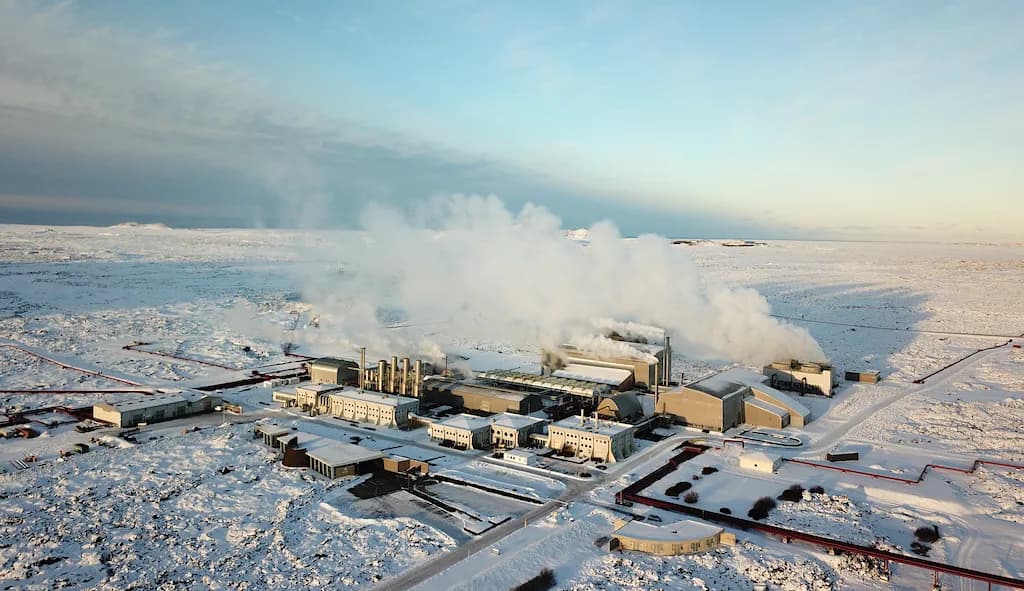
Research on geothermal heat in Iceland has led to its division into high-temperature and low-temperature areas. The division can be defined in two ways:
- On the basis of temperature in boreholes. Where a temperature of 200°C is measured above 1000 m depth in a borehole it is called high-temperature.
- On the basis of substances dissolved in the hot water. Under that definition, acidic springs (steam and mud pots) belong to high-temperature areas.
High-temperature areas
High-temperature areas occur within the active volcanic belt in Iceland and, as a continuation of it, along the mid-ocean ridges to the south and north of the country. On land the areas number 25 to 40 depending on how they are counted, of which 5-6 lie beneath glaciers. The boundaries between high-temperature areas are not always sharp. For example, people sometimes speak of one large high-temperature area in Hengill, meaning Nesjavellir, Innstidalur, Kolviðarhóll, Hveradalir, Hverahlíð, Fremstidalur, Ölkelduháls and Grændalur up above Hveragerði. In reality one could just as well speak of three high-temperature areas there.
Formation of high-temperature areas
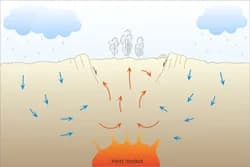
High-temperature areas form because of hot intrusions deep in the ground. In volcanic systems the density of intrusions is greatest in central volcanoes. The intrusions take the form either of dykes of various kinds or of larger rock masses of gabbro, dolerite, granophyre or granite. They are 1000-1200°C hot at the outset. Cold groundwater is heated near such heat sources, becomes lighter as it heats and rises upward toward the surface. Part of it cools and moves down to the margins, and circulation systems are established, which are one of the characteristics of high-temperature areas. Magmatic gases, such as SO2 and CO2, mix into the groundwater, react there and are carried with it to the surface.
At the coast the sea plays the same role as the groundwater farther inland and carries the heat from cooling intrusions up to the surface. Nearest the coast the high-temperature systems are therefore saline or brackish, and the chemical content of the geothermal fluid is similar to that of seawater, although some substances are precipitated out while the concentration of others increases. The saline high-temperature systems offer more varied utilisation possibilities than the freshwater systems. The seawater chemical processing at Reykjanes is an example of this. The Blue Lagoon is a by-product of high-temperature utilisation at Svartsengi for space heating and electricity generation, and is classed among the positive environmental effects.
The heat sources of the high-temperature areas vary in strength. The most powerful high-temperature areas are mainly in those areas where volcanic activity has been greatest in the geological present, that is, since the Ice Age ended a little over 10,000 years ago, but there are exceptions to this. Thus, for example, no high-temperature area is defined in Hekla itself, which has been one of the most powerful central volcanoes in the country throughout the present and longer. In its roots, however, there is no doubt a high-temperature system that has not yet reached the surface, and the same is true of several other large, active central volcanoes. In fact, the high-temperature areas, as we see them at the surface, rarely reach the surface until relatively late in the lifetime of the central volcanoes, and especially after caldera subsidence has occurred in them. The fate of all central volcanoes and volcanic systems in Iceland, and thereby of all high-temperature areas, is to drift out of the volcanic belt, cool there in the fullness of time and be eroded down by glaciers and water. On the way, the high-temperature areas turn into low-temperature areas, and an example of one such is found, for instance, in the Laugarnes area in the middle of Reykjavík. In Iceland numerous central volcanoes are known in the old bedrock of West, North and East Iceland. Some are eroded down to their roots all the way to 1500-1800 m depth, and in them one can examine extinct high-temperature areas. The dykes and intrusions at the bottom of them are the ancient heat sources.
Characteristics of springs and pools in high-temperature areas
In high-temperature areas the groundwater of the geothermal systems (the deep water) is at boiling point. From this follow two main types of spring.
Clear boundaries exist only between true steam vents, where there is no surface water, and continuously boiling water springs where there is most surface water. Mud pots lie in between.
In addition to the main types, other variants occur where the high-temperature areas have moved into the cooling stage. Then carbonated springs and carbon-dioxide pools form, either with or without calcareous deposits, first out toward the margins.
The outflow of the high-temperature areas appears in various ways at the margins or far beyond them, as deep-water-mixed or heated groundwater. In lava fields, steam vapour rising from it can sometimes be seen.
- Water springs where the deep water comes up. The deep water is rich in silicic acid, and sinter precipitates out where it emerges, generally near or a few tens of metres above the cold groundwater table of the surroundings.
- Steam vents where the groundwater of the geothermal systems lies deep and steam and gas boil out of it and rise to the surface. Steam and gas that boil up off the deep water mix with surface water, turn into condensate (the steam) or escape. There, hot patches with steam and mud pots form. There is great variety among them, all depending on the gas content of the steam and on how it meets surface water.
Classification of surface geothermal heat in high-temperature areas
- Deep water, springs with chloride-rich water
- Steam-vent areas
- Explosion craters
- Carbon-dioxide springs - pools and carbonated springs
- Outflow from high-temperature areas
- Geothermal areas in glaciers
- Human works in geothermal areas
- Extinct phenomena