

Classification of surface geothermal heat in steam-vent areas:
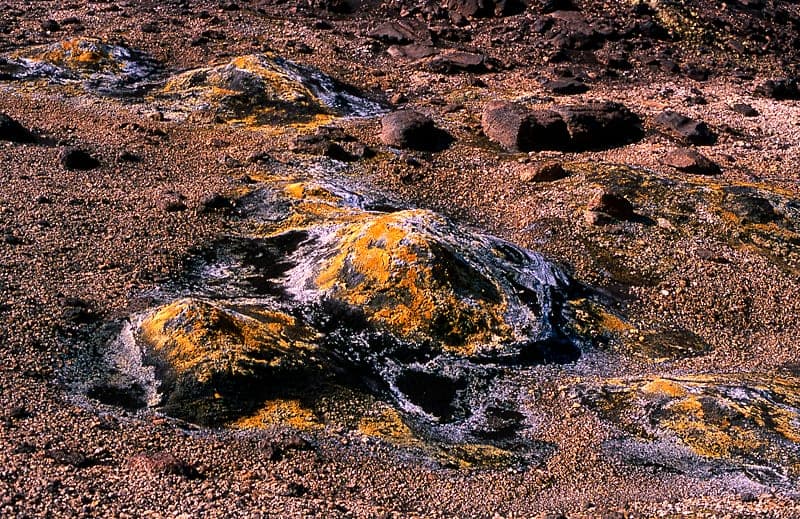
Sulphur mounds
Sulphur mounds form in high-temperature areas where there is much hydrogen sulphide in the steam. The largest sulphur mounds can be 10-20 m in diameter and 1-1.5 m high. Sulphur mounds are most numerous at Námafjall and in Fremrinámar, Krafla and Krýsuvík. Gypsum crusts bear witness to extinct sulphur springs.
Found at: Trölladyngja, Krýsuvík-Seltún-Sveifluháls, Austurengjar, Brennisteinsfjöll, Innstidalur, Hellisskarð, Vonarskarð, Kverkfjöll, Fremrinámur/Heilagsdalur, Hverarönd/Námafjall, Bjarnarflag, Krafla, Þeistareykir
Geothermal salts
In many places in high-temperature areas, geothermal salts precipitate out which are very readily soluble in water and therefore disappear in rains. After long dry spells the geothermal salts are very conspicuous and colourful.
Red mounds
Red mounds form where wind-blown sand settles around steam vents and cements together and oxidises. The largest are 4-5 m in diameter and 1-1.5 m high. Red mounds are common in Fremrinámar.
Steam vents in sand
Steam vents can form in sand where steam streams up through loose wind-blown sand. The steam forms a moist sand collar around the vent. Steam vents are found in several places in Fremrinámar. They may perhaps develop into red mounds over time.
Hot ground or patches
Hot ground, or patches with steam vents and mud pots, is the most common phenomenon of the high-temperature areas. The size ranges from a few square metres up to several hectares. The rock is boiled apart into clay and bleached, and characteristic are geothermal salts around the steam vents. Found at: Reykjanes, Eldvörp, Sandfell, Trölladyngja, Krýsuvík-Seltún-Sveifluháls, Austurengjar, Nesjavellir/Hagavíkurlaugar, Innstidalur, Hellisskarð, Hverahlíð, Ölkelduháls, Grændalur/Hveragerði, Geysir, Prestahnúkur, Hveravellir, Kerlingarfjöll, Landmannalaugar, Jökulgil, Vestur-Reykjadalir, Austur-Reykjadalir, Ljósártungur, Köldukvíslarbotnar, Vonarskarð, Grímsvötn, Kverkfjöll, Askja, Fremrinámur/Heilagsdalur, Hverarönd/Námafjall, Bjarnarflag, Krafla, Vestursvæði/Sátur, Þeistareykir.
Steam vents
Steam vents with powerful steam plumes occur in many high-temperature areas. They are often visible from afar and attract notice. The groundwater that is above boiling point lies so deep that it rises to the surface in the form of steam, and so no water becomes visible at the surface. The most powerful steam vents blow dry steam, often with a hiss (a transparent plume nearest the vent), more than 100°C hot. There are several examples of powerful steam vents that have formed recently (Dalaskarð above Hveragerði, the Republic spring in Krafla) and others that have died out or lost their strength (Hverinn eini at Trölladyngja).
The same spring can be both a steam vent and a mud pot, just not at the same time. In great droughts a mud pot can dry up and become a steam vent.
In the steam that comes up in high-temperature areas there are various gases, mainly carbon dioxide, hydrogen and hydrogen sulphide.
Found at: Trölladyngja, Krýsuvík-Seltún-Sveifluháls, Austurengjar, Nesjavellir/Hagavíkurlaugar, Innstidalur, Hellisskarð, Hverahlíð, Ölkelduháls, Grændalur/Hveragerði, Hveravellir, Kerlingarfjöll, Eyjafjallajökull, Landmannalaugar, Jökulgil, Vestur-Reykjadalir, Austur-Reykjadalir, Ljósártungur, Vonarskarð, Grímsvötn, Kverkfjöll, Krafla.
Superheated steam vents
Superheated steam vents with very powerful steam plumes occur in Kerlingarfjöll and Torfajökull. They are visible from afar and attract notice. The most powerful blow dry steam, often with a loud hiss (a transparent plume nearest the vent). Stones can float in the steam plume nearest the vent. Temperatures of up to 150°C have been measured.
Mud pots
The colour of mud pots varies according to which minerals and chemical compounds predominate in the clay. Most common is greyish geothermal clay, the grey colour stemming from clay minerals. Yellow geothermal clay stems from sulphur, while iron compounds make the clay brownish. Found at: Reykjanes, Trölladyngja, Krýsuvík-Seltún-Sveifluháls, Austurengjar, Nesjavellir/Hagavíkurlaugar, Innstidalur, Hellisskarð, Ölkelduháls, Grændalur/Hveragerði, Hveravellir, Kerlingarfjöll, Landmannalaugar, Jökulgil, Vestur-Reykjadalir, Austur-Reykjadalir, Ljósártungur, Vonarskarð, Kverkfjöll, Askja, Hverarönd/Námafjall, Krafla, Þeistareykir.
Boiling vats
Boiling vats are continuously boiling water springs with almost clear water and little outflow. They boil vigorously. Sometimes they are in cavities at bedding planes where groundwater seeps in. Many springs of this kind are in the Torfajökull area.
Boiling pans
Boiling pans are shallow springs with almost clear water where it bubbles up boiling in countless tiny vents in the bottom, similar to boiling in a pot. There is generally a small outflow from such springs. Boiling pans are common in high-temperature areas.
Black-water streams
Warm ground
Warm ground is common in the high-temperature areas where the soil structure is favourable for heat emission, for example gravel ridges or other porous rock. Here there can be large patches, tens of square metres and beyond. They are little noticeable in summer, unless there is some vegetation, but are best seen in winter when they melt the snow off themselves.
Hot clay flats
Hot clay flats is the name given to melt-out areas in high-temperature areas where the geothermal heat has boiled rock into clay. This is the case in many places in high-temperature areas, including on the southern slopes of Krafla. They are otherwise barren of vegetation.
Stream geysers
Stream geysers are a phenomenon where a small stream runs down into a spring vent until it overflows. In it, it simmers for a while until the spring erupts the water out of itself and empties. About 10 minutes pass between eruptions. The name comes from the geologist Guðmundur Ómar Friðleifsson, who so named one spring in Vondugil in the Torfajökull area. Another such spring is far up in Grænagil in the same area. A spring in Hrafntinnusker, now called Fordyrið, is also of this kind.
Found at: Landmannalaugar, Austur-Reykjadalir.
Steam-heated pools
Steam-heated pools are common in high-temperature areas where landslides have covered hot ground. The landslides are good groundwater conduits (false ones, in fact). Steam from deep water comes up and then the surface water heats, and pools appear lower down in the landslides. A handy example is in Grændalur, but pools of this kind are also in Hengill, Torfajökull, Vonarskarð and elsewhere.
Found at: Trölladyngja, Krýsuvík-Seltún-Sveifluháls, Austurengjar, Nesjavellir/Hagavíkurlaugar, Innstidalur, Grændalur/Hveragerði, Prestahnúkur, Hveravellir, Landmannalaugar, Austur-Reykjadalir, Vonarskarð, Krafla, Suðursvæði/Hvíthólar.