

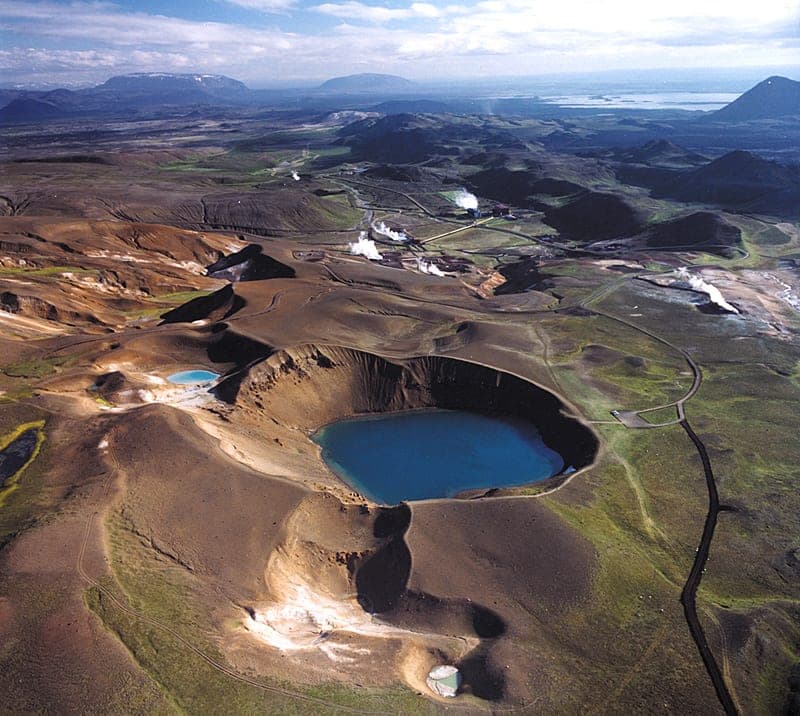
Volcanic craters that have developed into explosion craters occur in several high-temperature areas. They originate in volcanic eruptions where water from a geothermal system has sought into the eruption conduit and boiled up out of it. Recent examples are the Víti craters in Krafla and Askja. Hvannstóð west of Krafla is a prehistoric crater of the same kind. Where eruption fissures lie over a high-temperature area, explosion craters occur and more scoria in craters than outside. Water from a geothermal system is also the cause there. The clearest examples are in Trölladyngja and Krýsuvík, but the same is also seen in Innstidalur in Hengill, Bjarnarflag and perhaps elsewhere. The examples cited above are all from the present, that is, after the end of the Ice Age. In some of the high-temperature areas there are explosion craters and even clusters of explosion craters from the Ice Age or the end of the Ice Age, for example in Krafla, Trölladyngja, Hengill and Kverkfjöll. They may have formed when the pressure state went out of equilibrium during glacial outburst floods or with a sudden lowering of the groundwater table at the end of the Ice Age.
Found at: Trölladyngja, Krýsuvík-Seltún-Sveifluháls, Austurengjar, Kverkfjöll, Askja, Krafla, Krókóttuvötn
Minor hydrothermal explosion craters
Minor hydrothermal explosion craters are fairly common in high-temperature areas. They form when water flash-boils at shallow depth. The spring bowls are a few metres deep and 30 to well over 50 m in diameter for the largest. There are several recent examples of hydrothermal explosions, all of which have occurred in connection with earthquakes (Hveragerði and Reykjakot above it, Austurengjahver in Krýsuvík) and then on the source fractures.
Found at: Trölladyngja, Krýsuvík-Seltún-Sveifluháls, Austurengjar, Grændalur/Hveragerði, Landmannalaugar, Vestur-Reykjadalir, Austur-Reykjadalir, Kverkfjöll, Krafla, Leirhnjúkur, Þeistareykir
Carbon-dioxide explosion craters
Carbon-dioxide explosion craters are explosion craters of uncertain origin and occur in the Hengill area. They are in tuff mountains north-east of Ölkelduháls and much younger than the mountains themselves (Smjördalur in Súlufell and Katlatjarnir). The craters are a few hundred metres in diameter, round, except where they grip into one another, but no ejecta can be traced to them. Pillow-lava ridges formed after the craters, probably in the same eruption. There is much carbon dioxide in the springs at Ölkelduháls.
Found at: Ölkelduháls