

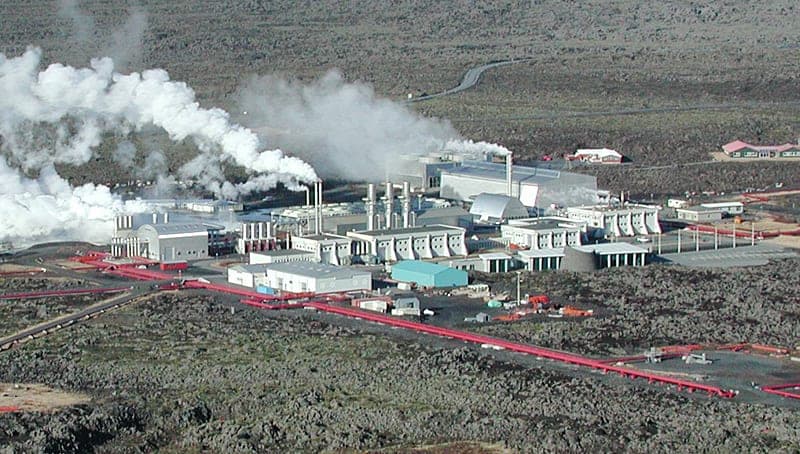
Power stations have been built in several high-temperature areas. The three largest are also stopping places for tourists where the operations are presented (Nesjavellir, Svartsengi and Krafla).
Display wells
Blowing boreholes that attract tourists. Three have been most popular. One was in Krýsuvík (in Seltún), another is above Hveragerði (the "Queen's well") and the third in Eldvörp on the Reykjanes peninsula.
Blowing dry-steam wells
Blowing dry-steam wells from the beginning of high-temperature drilling are east of Námaskarð. Stones have been piled around the well-heads and the steam rises up out of them. Few people know that these are old boreholes.
Steam explosions
Steam explosions out from boreholes have occurred in Krýsuvík (1999), Bjarnarflag (1967) and Krafla (1976). What remain are crater bowls a few tens of metres in size. In Krýsuvík an old borehole in Seltún blew up, where there is now a popular stopping place for travellers.
A revived geyser
The Geysir Committee saw to it at the time (1963) that Strokkur was revived by drilling. It was drilled 40 m down into it and it has erupted ever since, much as now. Strokkur came to life with the earthquake of 1789 (rather 1784, though) but died out in the earthquakes of 1896. When the spring subsides, remains of a rectangular drilling pad can be seen.
A man-made geyser
In Hveragerði people learned how to make artificial geysers before 1940. These artificial geysers were boreholes in the geothermal area (the so-called Tourist well) and the most popular one up by Hamarinn (called Bogi after the owner and the jet, actually not a true borehole). This was last attempted a decade or so ago but did not succeed as it should, since the interval between eruptions became rather too short. This last artificial spring is below the bridge over Varmá toward Gufudalur and was given the name Leppalúði to match Grýla a short way from there.
Carbon-dioxide extraction
Carbon-dioxide extraction at Hæðarendi in Grímsnes is based on carbon-dioxide-rich water from a 165-185°C hot geothermal system (a high-temperature system in the cooling stage). The unusually abundant scoria in craters nearby (Seyðishólar) is probably due to the carbon dioxide.
Effluent lagoons
Effluent lagoons are at all high-temperature power stations, most of them close by, but about 10 km away from Krafla power station. In all cases the water from them eventually leaks down into lava and disappears. The water of the Blue Lagoon at Svartsengi and the Grey Lagoon at Reykjanes is salty, but fresh in the other lagoons, which are at Nesjavellir, Bjarnarflag and at Búrfellshraun. There is rich birdlife at the two last-named and on the stream above them.
Bathing places
Bathing places have been made in many high-temperature areas. A hot stream is then usually dammed to form a bathing pool. Such places are found, for example, at Hveravellir, the Torfajökull area and the Hengill area.
Sulphur extraction
Traces of such are pits, shelters, house foundations and cairns. Remains of sulphur extraction in former times are in Brennisteinsfjöll and Fremrinámar, and from the 20th century at Námafjall.
Terraced rims
Terraced rims of silica sinter have formed in a few places in the channels of effluent water from boreholes. A large sinter sheet with terraced rims is by the salt factory at Reykjanes, between the separator and the Grey Lagoon