

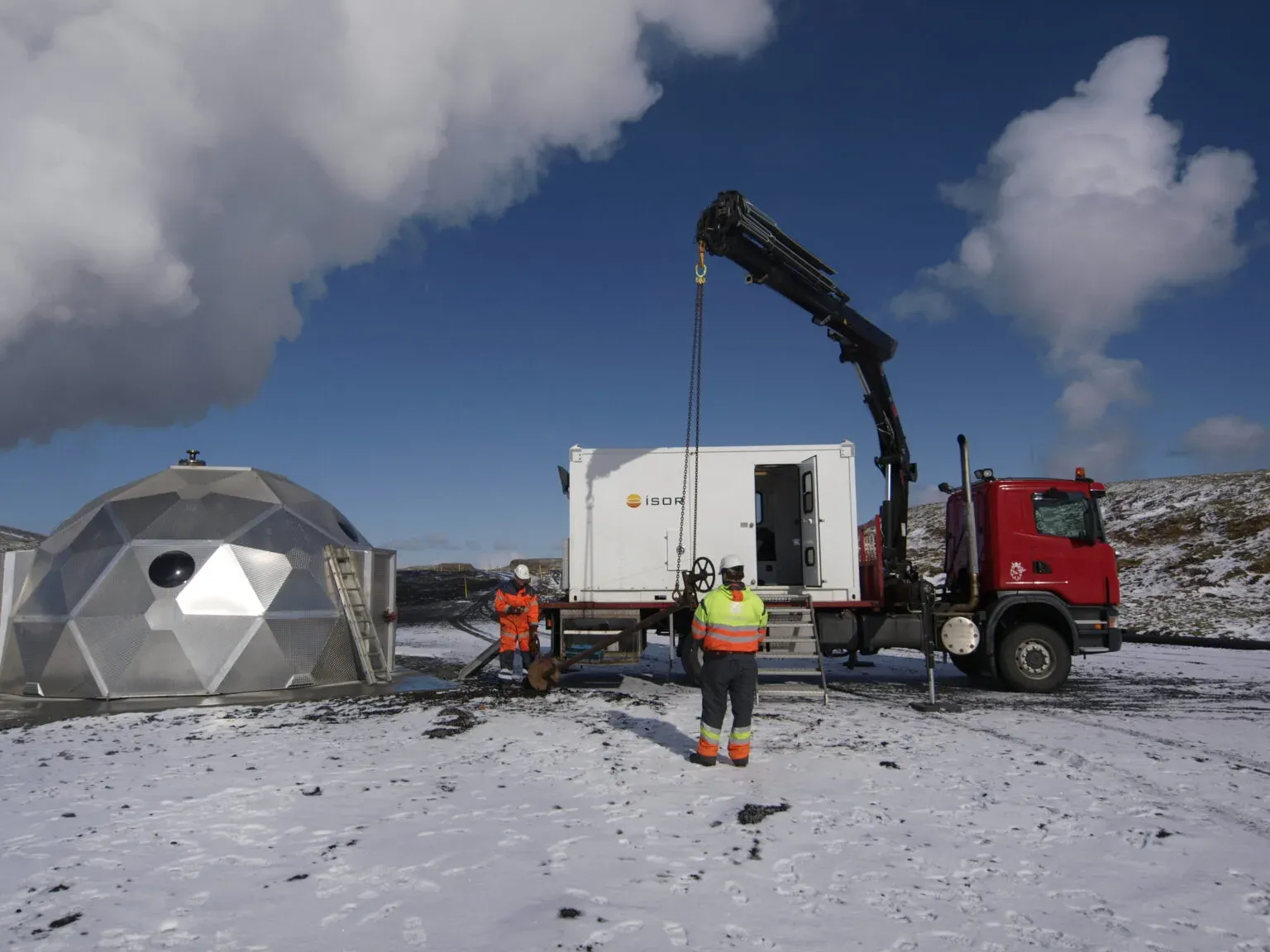
ÍSOR provided geological consultancy for the drilling of a new well, LH-4, for Skagafjarðarveitur. The water yield from the new well proved far greater than expected and the temperature higher. Some 4 L/s and a water temperature of about 100°C had been hoped for, but more than 30 L/s came up and the temperature was as high as 110°C. It is uncommon to obtain such hot water from shallow boreholes in low-temperature areas in this country. The water will be used in a district heating system across Fljót that Skagafjarðarveitur is building.
Geothermal heat in Tröllaskagi
Geothermal heat is fairly widespread in the outer part of Tröllaskagi. There are district heating systems, for instance, in all the population centres, the newest being at Hofsós. There hot water from Hrollaugsdalur is used, found after extensive geothermal exploration. In recent decades Skagafjarðarveitur has also laid quite long pipelines into the rural areas of the district, and the great majority of it is now supplied with geothermal heat.
Earlier research and geothermal exploration
Geothermal heat in Fljót has long been known in a good many places and was studied a little in the 1980s. Hot water was and is used on several farms there, especially in the vicinity of Reykjarhóll in Austur-Fljót and no less at Barðslaug and Sólgarðar, where there is a school and a swimming pool.
Fairly extensive surface surveys had been carried out in the district before 1990, and by then it had become clear that the geothermal heat generally followed north-south fractures. Chemical analyses indicated that it was hottest in the westernmost part of the area, at Barðslaug and Reykjarhóll á Bökkum, but that lower temperatures could be expected in Austur-Fljót. In both of these areas the chances of geothermal heat were thought to be quite good according to resistivity measurements.
Two fish-farming stations were established in the 1980s in Fljót near known geothermal sites; one at Lambanesreykir/Hraun and the other at Reykjarhóll á Bökkum, and at both places hot water was drilled for. Neither of these fish farms has survived despite the hot water.
In the area outside Barð there is geothermal heat on the land of Langhús. The place was formerly called Dælislaug and was first drilled at in 1997 after problems arose in using the pool. A fracture was then found that gave boiling-hot water at less than 80 m depth. It was drilled there again in 2014, then down to about 200 m depth. Much more water was then obtained, enough for Skagafjarðarveitur to begin a district heating pipeline across Fljót. Something was still lacking, however, in reaching sufficient water volume, but the first stage of the pipeline across Austur-Fljót and Stífla was completed in the summer of 2015. At the same time a new well was drilled which did not succeed. It was clear that the fracture supplying the geothermal heat dipped differently from what ÍSOR's consultants had thought.
The fourth well, LH-4, was sited with that in mind, and was drilled in 2015-2016. It became 170 m deep and was then flowing about 30 L/s, which is considerable.
Results
In the area, very hot water is obtained at unusually shallow depth. It had been expected beforehand that the water would have to be pumped up. The wells were therefore designed with boiling water in mind. The outcome, however, was that abundant self-flow was obtained there.